


How to Design an ISO 11064-Compliant Control Room Console: Ergonomics, Sightlines, and Thermal Management

Executive Summary: ISO 11064 at a Glance for Console Planners
ISO 11064 (Ergonomic design of control centres) is the international benchmark governing the physical architecture, workstation layout, and human-system interfaces of 24/7 mission-critical operations.
For control console manufacturers and command center engineers, compliance is primarily driven by:
ISO 11064-1: Principles for the design of control centres.
ISO 11064-2: Principles for the arrangement of control-suite architectural spaces.
ISO 11064-3: Control room layouts, clearance envelopes, and acoustic/visual zones.
ISO 11064-4: Layout and dimensions of operator workstations and physical consoles.
An ISO 11064-compliant console is not merely a desk; it is an engineered human-machine interface designed to sustain high vigilance, eliminate cognitive fatigue, prevent musculoskeletal disorders, and ensure rapid response during critical incidents.
Technical Parameter | ISO 11064 Recommendation | Engineering Best Practice |
Viewing Distance (Primary) | 500 mm – 750 mm | Displays tilted ≤ 15° perpendicular to eye line |
Vertical Sightline Arc | Preferred 0° to -30° | Resting eye line at -15° below horizontal |
Sit-Stand Motorized Range | 650 mm to 1250 mm | Accommodates 5th female to 95th male percentiles |
Leg Clearance & Envelopes | Knee depth ≥ 600 mm | Total depth clearance ≥ 800 mm without obstruction |
Thermal Dissipation | Max ΔT ≤ 10°C over ambient | Dual-path chimney venting + low-noise fans (< 45 dBA) |
Structural Rigidity | High live-load stability | Total deflection < 2 mm under 150 kg operational load |
1. Ergonomic Sightlines and Display Hierarchy (ISO 11064-3 & 4)
In mission-critical environments such as Security Operations Centers (SOC), Air Traffic Control (ATC), and power generation grids, operators simultaneously monitor personal console screens, overview video walls, and physical emergency switches.
Visual Zone | Angular Range (Relative to Eye Line) | Equipment & Operational Focus |
Overview Video Wall | 0° to +15° (Max upward gaze) | Shared situational maps, SCADA topology, overview alarms |
Primary Displays (24"–32") | 0° to -15° (Optimal resting cone) | Active radar, live video feeds, primary dispatch UI |
Secondary Panels | -15° to -30° (Downward gaze) | Auxiliary touchscreens, tactile intercoms, emergency switches |
Desktop Worksurface | Resting forearms at 90°–105° | Keyboard, mouse, desktop documentation, physical clearance |
1.1 The Primary Viewing Zone
Vertical Range: The optimal resting line of sight is 15 degrees below horizontal. All mission-critical monitors (SCADA screens, active alarm lists, radar feeds) must be centered between 0° and -30° relative to horizontal eye level.
Horizontal Sweep: The primary visual angle without neck rotation is 30° (15° left / 15° right). Displays within this cone receive 80% of fixation time.
Curved Arrays vs. Flat Spans: When an operator manages 3 or more displays, flat planar mounting causes focal degradation at the outer screen edges. ISO 11064 mandates curved radial mounting (focal radius of 650–850 mm matching natural head rotation).
1.2 Video Wall Line-of-Sight Integration
Console profile heights must prevent "sightline clipping." The top edge of desktop monitors must sit below the lower sightline ray extending from the seated operator’s eye to the bottom border of the shared overview video wall.
Console monitor rails must feature independent motorized or mechanical height and depth adjustment to accommodate operators across anthropometric distributions.
2. Anthropometric Dimensions: Designing for the 5th to 95th Percentile
To satisfy ISO 11064-4, control consoles must fit the 5th percentile female to the 95th percentile male population. Fixed-height furniture cannot meet this standard.
Dimensional Parameter | Seated Target (mm) | Standing Target (mm) |
Worksurface Height | 650 mm – 780 mm | 950 mm – 1250 mm |
Thigh Clearance Depth | ≥ 450 mm | Full clearance |
Knee Space Width (per operator) | ≥ 800 mm | ≥ 800 mm |
Footrest Depth & Enclosure | ≥ 350 mm | Floor level |
Primary Reach Zone (Controls) | ≤ 400 mm | ≤ 400 mm |
Maximum Reach Zone (Secondary) | ≤ 600 mm | ≤ 600 mm |

2.1 Dual-Surface vs. Single-Surface Sit-Stand Mechanisms
Single Worksurface with Independent Monitor Arms: Both the keyboard area and the monitors lift synchronously via high-torque dual or triple synchronized linear actuators. Fine monitor adjustments are handled via articulated gas-spring arms.
Dual Worksurface (Keyboard + Monitor Tier): Provides separate motorized elevation for keyboard decks and monitor tiers. While flexible, it requires anti-pinch safety sensors to prevent equipment crushing during independent travel.
3. Structural Integrity, Cable Architecture, and Thermal Dissipation
Mission-critical consoles house sensitive computing, network switches, KVM matrices, and high-density power distribution units (PDUs). Thermal failure or cable interference directly compromises facility uptime.
3.1 Passive and Forced-Air Thermal Management
Electronic hardware inside enclosed equipment bays can raise internal ambient temperatures by 15°C to 25°C above ambient room conditions, leading to processor throttling and component failure.
Engineered Chimney Effect: Vented lower access kick-plates draw cool floor-level air across rack-mounted PCs, discharging heated air through rear top-cap louvers.
Low-Noise Forced Convection: Where high-density blade servers or dual high-wattage workstations are installed within the console bay, thermostatically controlled ultra-quiet brushless DC fans (rated < 45 dBA) maintain internal cabinet temperatures below 35°C without generating acoustic distraction.
3.2 High-Voltage / Low-Voltage Physical Separation
Electromagnetic Interference (EMI) Mitigation: AC power distribution (110V/220V) and sensitive high-speed low-voltage data cables (Cat6A, fiber optics, USB, HDMI/DisplayPort) must be routed in physically separated, grounded steel wireways.
Articulated Cable Chains: For height-adjustable sit-stand workstations, heavy-duty vertical cable vertebrae prevent cable binding, pinching, or cycle-fatigue disconnects over tens of thousands of lift operations.
4. Materials, Acoustics, and Durability Standards
24/7 mission-critical operations represent continuous physical wear that commercial office furniture is incapable of withstanding.
Worksurface Materials: High-pressure laminate (HPL) with seamless molded polyurethane (PU) or solid-surface bullnose edges. Polyurethane edging eliminates sharp pressure points on operator wrists and will not chip, peel, or harbor contaminants.
Anti-Glare Matte Surfaces: Specular reflection on console tops causes pupil dilation fatigue. Worksurfaces must maintain a diffuse matte finish with a light reflectance value (LRV) between 0.20 and 0.40.
Cold-Rolled Steel Subframe: Internal framing must be manufactured from high-grade structural cold-rolled steel (minimum 1.5 mm to 2.5 mm wall thickness) finished in electrostatic anti-corrosion powder coating, ensuring zero frame racking or vibration under heavy typing or peripheral operations.
5. Kesino Engineering Implementation: How KCA & KCF Consoles Comply
As a direct OEM manufacturer specializing in mission-critical command furniture, Kesino engineers its modular console series to directly address ISO 11064 physical and operational criteria.
Console Series | Structural & Ergonomic Form | Primary Mission Profile |
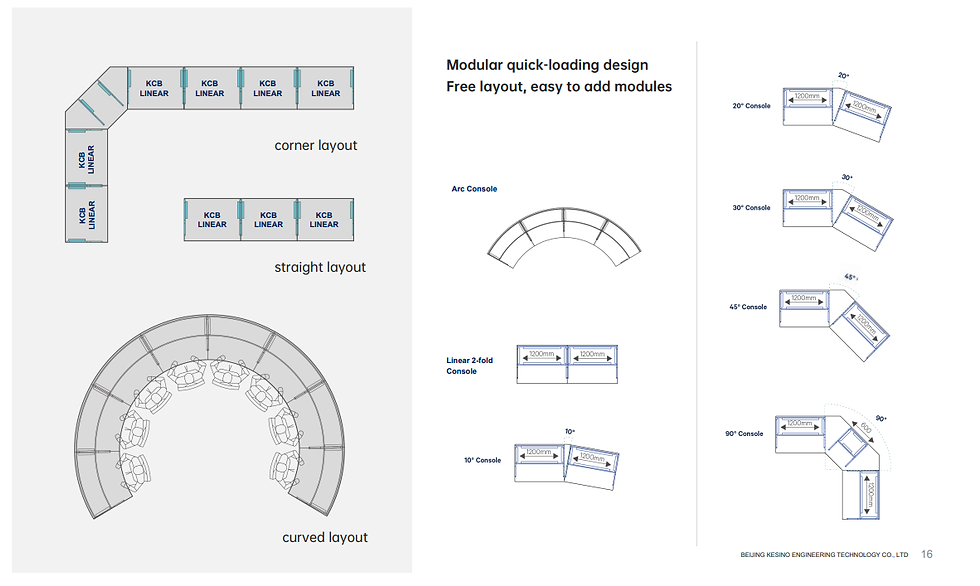
Kesino KCA Series | Modular Curved Arc / Linear Console | Security Operations Centers (SOC) |
Kesino KCF Series | Motorized Dual-Stage Sit-Stand Console | Emergency Dispatch (911 / PSAP) |
Kesino KCB Series | High-Density Multi-Tier Operations Desk | Air Traffic Control & Aviation |
Kesino KCH Series | Heavy-Duty Industrial Monitoring Console | Power Utilities & Chemical Plants |

Practical Engineering Highlights
Precision 3D Clearance Modeling: Every Kesino layout is validated through 3D CAD and VR sightline simulations prior to manufacturing, ensuring clear operator viewing angles to overview wall displays regardless of ceiling height constraints.
Modular Expandability: Cold-rolled steel subassemblies use precision-machined interlocking modules, allowing command centers to scale from 2-operator pods to 50-operator curved command suites without structural re-engineering.
High-Load Linear Actuators: KCF sit-stand variants incorporate certified multi-column lift systems featuring anti-collision gyro-sensors, smooth soft-start/stop damping, and dynamic loads exceeding 200 kg.
Built-in Power & PDU Infrastructure: Standard integrated 19-inch rack-mount equipment bays with brush-strip access ports for tool-free hot-swapping of maintenance peripherals.
6. ISO 11064 Console Specification Checklist for Tenders
When preparing public or private request-for-proposal (RFP) documentation, include the following verifiable clauses to mandate ISO 11064 compliance:
Sightline Verification: Vendor must submit 3D eye-level sightline diagrams demonstrating unobstructed visibility from seated (5th percentile female) and standing (95th percentile male) positions to all console screens and central display walls.
Adjustment Envelope: Motorized sit-stand consoles must cover a continuous height range from 650 mm to at least 1250 mm with acoustic noise ≤ 48 dBA during transition.
Ergonomic Edging: Operator-facing surfaces must feature integrally molded polyurethane (PU) soft edges with a minimum 25 mm radius to prevent forearm circulatory restriction.
Cable Management: Dedicated dual-channel steel wireways with physical galvanic separation between AC power lines and data signaling cabling.
Thermal Dissipation: Dedicated vented equipment compartments capable of maintaining internal hardware delta T ≤ 10°C over room ambient during continuous 24/7 full-load operation.
Certified Manufacturing: Manufacturer must possess ISO 9001 (Quality), ISO 14001 (Environmental), and BIFMA structural test certifications.
7. Frequently Asked Questions (FAQ)
Q1: Is ISO 11064 certification mandatory for all command centers?
While ISO 11064 is an international standard rather than a punitive law, it is routinely mandated as a mandatory compliance specification in government, military, aviation, and major utility infrastructure tenders globally. Non-compliant control rooms exhibit significantly higher operator error rates and fatigue-related absenteeism.
Q2: What is the ideal focal distance for multi-monitor command workstations?
Under ISO 11064-4, the recommended visual distance for primary monitors (1920x1080 to 4K resolution) ranges between 500 mm and 750 mm. Display arms must provide tilt (-5° to +15°) and focal depth adjustment so operators can align focal distances without leaning forward.
Q3: How do motorized sit-stand consoles impact 24/7 operator health?
Shift-work studies confirm that alternating between sitting and standing (e.g., 45 minutes sitting / 15 minutes standing) enhances blood circulation, reduces lumbar spinal compression, boosts alertness during overnight graveyard shifts, and prevents musculoskeletal disorders (MSDs).
Q4: Can standard commercial office sit-stand desks be used in control rooms?
No. Standard commercial office sit-stand desks are engineered for intermittent 8-hour consumer usage. They lack the continuous high structural rigidity, heavy equipment load capacity (>150 kg), equipment bay ventilation, 19-inch rack mounting, and multi-display focal arc mounting required for 24/7 mission-critical operations.
Q5: How do curved console layouts improve situational awareness?
Curved or semi-circular console configurations (such as Kesino KCA and KCB arrays) place all peripheral displays and tactile controls within the operator’s immediate reach and focal sweep without requiring lateral torso twisting, maintaining optimal ergonomics throughout long shifts.
Q6: What warranty period should be expected for mission-critical consoles?
Given continuous 24/7 operation, legacy brands typically offer 5 to 10 years of structural warranty. Direct OEM manufacturers like Kesino provide a comprehensive 10-year warranty on cold-rolled steel structural frameworks and mechanical hardware.
8. Standards & Reference Citations
International Organization for Standardization (ISO): ISO 11064-1 to 11064-7: Ergonomic design of control centres.
Occupational Safety and Health Administration (OSHA): Computer Workstations Ergonomics Standard (OSHA 3125).
Federal Aviation Administration (FAA): FAA Human Factors Design Standard (HF-STD-001B).
ANSI/BIFMA: ANSI/BIFMA X5.5 - Desk and Table Products Standards.
National Institute of Standards and Technology (NIST): NIST SP 800-53: Security and Privacy Controls for Information Systems and Organizations.


Comments